
Dwight D. Eisenhower and the Origins of Sister Cities International
Written by: Nikash Runton
Cary Sister Cities ‘26 Social Media Intern
In the aftermath of the two World Wars, Dwight D. Eisenhower faced an apparent contradiction. A man who had spent most of his career directing military operations now had to become a strong advocate for peace among ordinary people. But what he did extended beyond simply treaties and negotiations between governments; he wanted to build relationships between the citizens themselves. He understood that lasting peace was not something a document with signatures could create, but rather something that needed to be formed through connections in society and culture. This idea became especially important during the Cold War, when distrust between nations easily led to distrust between people.
Eisenhower’s strongest effort to promote lasting peace was in the People-to-People Program, launched in 1956. The program encouraged Americans to establish personal, educational, and cultural relationships with communities in other countries. Among the developments that came from this program, one of the most important was the creation of Sister-City Affiliations, in which communities formed lasting relationships across borders. Although international city partnerships existed before Eisenhower, his administration gave the movement a national purpose. This purpose helped establish the foundation from which Sister Cities International developed.
Before Sister Cities connected communities around the world, President Dwight D. Eisenhower had an idea for building lasting peace: bringing ordinary people together. His 1956 People-to-People Program helped lay the foundation for a movement that still connects communities across borders today.
Works Cited
Dwight D. Eisenhower Presidential Library, Museum and Boyhood Home. “Chronologies.” Dwight D. Eisenhower Presidential Library, Museum and Boyhood Home. Eisenhower Library — Chronologies
National Archives and Records Administration. “D-Day.” National Archives. National Archives — D-Day
Dwight D. Eisenhower Presidential Library, Museum and Boyhood Home. “Presidential Years.” Dwight D. Eisenhower Presidential Library, Museum and Boyhood Home. Eisenhower Library — Presidential Years
Eisenhower, Dwight D. “Remarks at the People-to-People Conference.” 11 Sept. 1956. The American Presidency Project, University of California, Santa Barbara. American Presidency Project — Remarks at the People-to-People Conference
Dwight D. Eisenhower Presidential Library, Museum and Boyhood Home. “People-to-People Program.” Dwight D. Eisenhower Presidential Library, Museum and Boyhood Home. Eisenhower Library — People-to-People Program
United States Congress. “Sister-City Program.” Congressional Record, 29 June 1961. Congressional Record, 87th Cong., 1st sess., 1961. Government Publishing Office — Congressional Record, June 29, 1961
Sister Cities International. “Our History.” Sister Cities International. Sister Cities International — Our History
Eisenhower Foundation. “Dwight D. Eisenhower Legacy Organizations.” Eisenhower Foundation. Eisenhower Foundation — Legacy Organizations
The American Assembly. “Overview.” The American Assembly. The American Assembly — Overview
Eisenhower Fellowships. “A Distinguished History.” Eisenhower Fellowships. Eisenhower Fellowships — A Distinguished History
Library of Congress. “Dwight D. Eisenhower: A Resource Guide.” Library of Congress Research Guides. Library of Congress — Dwight D. Eisenhower: A Resource Guide
Dwight D. Eisenhower Presidential Library, Museum and Boyhood Home. Dwight D. Eisenhower: Post-Presidential Papers, 1961–69, 1967 Principal File. National Archives and Records Administration. Eisenhower Library — 1967 Principal File
Fett, Anna. “U.S. People-to-People Programs: Cold War Cultural Diplomacy to Conflict Resolution.” Diplomatic History, vol. 45, no. 4, Sept. 2021, pp. 714–742. Oxford Academic, https://doi.org/10.1093/dh/dhab055
From Abilene to the Allied Command
Dwight David Eisenhower was born in Denison, Texas, on October 14, 1890. He spent most of his childhood in Abilene, Kansas, where he graduated from Abilene High School in 1909 and entered the United States Military Academy at West Point in 1911. His early Army career included assignments and advanced military education that developed his defining organizational and leadership skills. [1]
Eisenhower’s career changed dramatically during World War II. After the U.S. joined the war, he rose rapidly through senior command positions and eventually became Supreme Allied Commander of the Allied Expeditionary Force in Europe. On June 6, 1944, he directed the opening phase of Operation Overlord, also known as the Allied invasion of Normandy. [2]
His wartime experience taught him about both international conflict and cooperation. Through his command of forces from several Allied nations, he had to cooperate with his team despite large differences in languages, national interests, and military traditions. After the war, he continued to hold significant positions, including Army Chief of Staff and commander of NATO forces in Europe. He later brought this international expertise into the White House after being elected President in 1952 and taking office in 1953. [1][3]
A President Looking Beyond Government
Eisenhower began his presidency during the Cold War, when relations between the United States and the Soviet Union were dominated by ideological conflict, competition, and the threat of nuclear war. Yet, Eisenhower’s approach to peace was not limited to power or negotiations between governments.
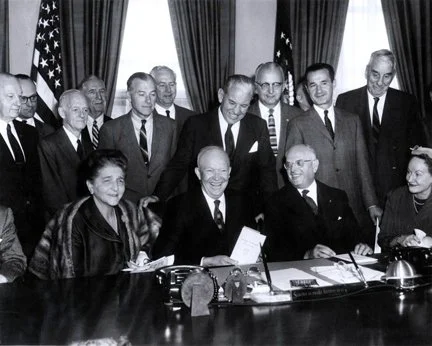
On September 11, 1956, Eisenhower addressed a White House conference for the People-to-People initiative. He promoted the idea of developing a greater understanding of each other across national borders and argued that any ordinary citizen could “build the road to peace.” [4]
Although his idea was simple, it was ambitious. It required that citizens of different countries communicate and know one another directly. The Eisenhower Presidential Library explains that the People-to-People Program promoted understanding through education, cultural, and humanitarian activities. Eisenhower envisioned pen-pal programs, international sporting events, musical performances, exchanges, hospitality programs, and, last but not least, city affiliations. [5]
The People-to-People Program and Sister Cities
Sister cities did not suddenly appear through one presidential announcement. International city-to-city relationships existed well before Eisenhower became president. For example, Toledo, Ohio, and Toledo, Spain established a partnership in 1931. [7] Rather, Eisenhower contributed the framework upon which the sister-city idea was built and connected it to a much larger system of citizen diplomacy.
Eisenhower did not simply create an organization called Sister Cities International in 1956. His administration created the People-to-People Program, within which sister-city affiliations began to build relationships with communities overseas. The Eisenhower Presidential Library notes that his program envisioned citizens, rather than the government alone, carrying out the program. [5]
The movement quickly expanded beyond the White House. A Civic Committee began building upon the sister-city component in 1956. In 1957, the American Municipal Association approved cooperation with the committee, and in Washington, D.C., in February 1958, a national sister-city conference took place. [7]
These developments illustrate Eisenhower’s main idea that Washington could encourage international relations while communities worked to build them themselves. As a result, diplomacy was no longer limited to presidents, ambassadors, and elected (or unelected) officials. Instead, students, families, teachers, businesses, organizations, local governments, and other citizens could participate as well.
Why Citizen Diplomacy Mattered
The strength of the idea was its accessibility. International relations did not have to begin with two officials, but rather students communicating with one another, families hosting visitors, or communities exchanging culture and traditions.
A 1961 Congressional Record discussion provides evidence of this approach. It described sister-city relationships as opportunities for citizens to exchange letters, books, photographs, recordings, and other materials. It identified these affiliations as part of the nationwide People-to-People Program, established by President Eisenhower in 1956 [6]
The program could not replace the treaties and legal documents signed by leaders, but it could help citizens become familiar with one another. Two governments could disagree, but their citizens could develop friendships and a better understanding of each other independent of their leaders.
At the same time, the program served America’s Cold War foreign-policy goals. Cultural exchange could strengthen America’s image and promote a greater understanding of American society. This combination of idealism and strategy explains why Eisenhower’s program became such an important part of his legacy. [13]
Eisenhower's Broader Legacy
The People-to-People Program was not Eisenhower’s only idea to promote understanding. His other organizations and initiatives also reflected his belief that working together could bring people together.
Before entering the White House, Eisenhower was president of Columbia University, where he established The American Assembly, an organization designed to examine important issues, national and international, by bringing together leaders and experts. [9]
In 1953, Eisenhower Fellowships was formed to foster the exchange of promising professionals with other countries. The organization sought to encourage an understanding between people from different countries through what their participants would bring back from their exchange trip. [10]
Eisenhower's involvement with People-to-People continued after he left office. In 1961, he became the first chairman of the board of trustees in a newly private People-to-People organization. [8] His post-presidential papers also contain records regarding People-to-People and the Town Affiliation Association, including information about the sister-city program. [12]
From Eisenhower's Vision to a Lasting Institution
The transition from People-to-People into Sister Cities International happened gradually. Although Eisenhower provided the vision and momentum to get things started, it fell on local communities, organizations, and leaders to turn this into a functioning network.
The movement’s timeline shows the following progression through the development of local affiliations and national conferences:
1956: People-to-People initiative
1967: Town Affiliation Association of the United States is incorporated [7]
Present day: Sister Cities International
Eisenhower’s legacy was not simply creating a nonprofit organization. He contributed a model through which communities began participating directly in international diplomacy. By the time of his death in 1969, the movement had developed beyond his presidency. It continued to grow afterward, eventually becoming Sister Cities International. The organization’s development shows that the movement eventually became sustained through its participating communities rather than depending solely on government support.
A Legacy That Begins Locally
Eisenhower’s greatest contribution to Sister Cities was not simply creating a program, but promoting a new way to build peace. He believed that by forming relationships between people, communities would strengthen relationships between countries. His 1956 People-to-People Program turned that idea into a growing movement of connections around the world.
What began as a presidential initiative became a lasting legacy carried forward by cities, students, families, and communities. For Eisenhower, peace was not built only through leaders and armies, but through people learning to understand one another.
Thank you.